


The recent bank runs and highly public bank failure of SVB has served to remind all of us about the myriad of risks that exist as we invest our money to reach future goals. Our environment post financial crisis (2008 until last year) was one of zero interest rates and very low inflation. That constrained the number of risk elements under consideration for a long period of time; Many investors got out of the habit of worrying about inflation and purchasing power risk and interest rate risk. As we emerged from the pandemic and resulting supply and demand mismatches, the Federal Reserve clearly signaled their focus on fighting inflation and their commitment to pivot to quantitative tightening. This was a regime change which shifts the risk landscape, investing equation, investing risk set, and the economic cycle.
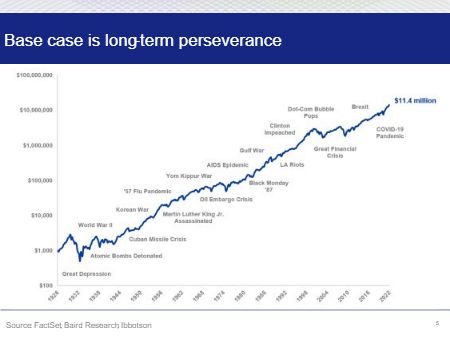
There are risks out there. There will be more (unknown at this time) events that serve to upend the markets and more importantly our confidence in them. In addition to the two banks that failed this year, there were four failures in 2020, another four in 2019, eight more in 2017; since 2009, 513 banks have failed (Source: https://www.fdic.gov/bank/historical/bank/). Did that impact your life? Probably not. Did any of those 513 bank failures make us worry about the end of the US financial system? Probably not. While we often are managing new, ‘never-happened-before’ issues; our country and key players seem to work our way through them. In the end, like the responses to the Global Financial Crisis of 2008-09, the pandemic’s rapid markets’ declines in March 2020 or the failure of the banks this year, when push comes to shove, we do the right thing. We provide help to those in great need, and we make good on investor’s deposits. There is, for sure, a lot of messiness along the way. Some groups get windfalls when they shouldn’t, some groups in need don’t get it quickly enough, some rich and powerful people get to cut the line. Some assistance is too little, too late. But we have demonstrated that we can work quickly when we need to put our fingers in the metaphorical dike. And this chart gives me quite a bit comfort—looking back almost 100 years with the depression, major wars, the Great Financial Crisis, pandemics/epidemics, if $1000 was invested in the stock market in 1926, in spite of all that, it would have been worth $11.4 million at the end of 2022. In other words, our economy has been quite resilient over the prior hundred years.
So that brings us to money anxiety. There are always risks. There is always a fear of loss. We work with our clients to help them navigate risks—even when we don’t always know which risk will raise its head next. It doesn’t mean clients won’t lose money. But by planning for liquidity needs and a couple of years of back-to-back bad markets, we can allow the market risks to unfold without creating an individual liquidity crisis that results in selling assets at the wrong time, and sometimes also creating a tax event that wasn’t necessary. Most risk events don’t last for long periods of time and so by providing cash cushions to weather the events, the event doesn’t create as much damage. Working with a good advisory team that helps you with your individual/family situation can help you get through these storms with just a few bumps and scrapes.
Here are a few tips:
1.). Make sure you have an emergency fund that will allow you to manage an unexpected expense, loss of a job, illness. Most say 6-12 months is best.
2.). If you are in the distribution phase of your portfolio, ensure liquidity. Make sure you have enough cash, dividends and interest income, pension and annuity income (very reliable sources of distributions) that will enable you to go 12-24 months without selling securities. This will prevent selling at a distressed prices and with taxable accounts, possibly triggering capital gains taxes.
3.). If, when your investment goal time horizon and risk profile changes, rebalance your asset allocation to your desired state. Reducing risk will reduce the volatility in the portfolio which is important as your time horizon shortens and your ability to recover from down markets is limited.
4.). For those in the distribution phase, craft a funding plan for your household expenses beginning with social security and adding in other guaranteed income sources like annuities and pensions. Then layer in predictable cash flows like qualified stock dividends and bond and money market and passive interest income. Finally add in volatile cash flows like royalties, securities appreciation, investment income. If your income layering is too volatile, you might consider moving some of your assets into more predictable or guaranteed vehicles. A smart advisory team can help you make decisions about when to begin social security and how to increase the predictability of your income stream.
5.). Take advantage of a big source of protection: Diversification. By using a handful of outside independent portfolio managers that have gone through a rigorous due diligence review, you are reducing manager, asset class, investment thesis risk. By investing in municipal bonds, for example, in different counties, states, parts of the country, you are reducing your dependence upon the local tax base, local economy and natural disasters. The same is true with parts of the world and the impact of geopolitical risk events.
6.). A Roth Retirement Account can be another buffer during challenging markets for investors over 59 1/2. These tax exempt accounts are free of Required Minimum Distributions and there is are no taxable implications for either realized gains or taking distributions.
7.). Make a plan and stick to your plan. Your plan is your guide. You might want to make some tactical course corrections depending on the conditions but your overall strategy is sound. Sticking to your plan can be one of the most difficult phases. As humans, we want to feel like we make decisions to react to the situation. But staying the course is likely the better decision.
If we can help you or your family and friends alleviate investor anxiety, please reach out to us palombogroup@rwbaird.com.
All investments carry a level of risk, including loss of principal. Asset allocation and diversification does not ensure a profit or guard against loss. Past performance is no guarantee of future result. Baird does not offer tax or legal advice.