


The back-to-back markets of 2022 and 2023 provide behavioral investor insight.
What a roller coaster and what a difference a year makes! In 2022 every asset class except the energy sector was down and in 2023 it was just the opposite! Last January, as the markets and investors were stinging from the losses of 2022, most were bracing for continued volatility in 2023. Had an investor decided to “sit out” 2023 to prevent more losses, it would have been a big mistake. The calendar year 2023 results S&P 500 delivered a 26.3% return, the Russell Midcap 17.2% and the MSCI EAFE of developed markets 18.9%. Even intermediate munis resulted in 5.0%. (Source: Baird 4Q23 Market Chartbook)
One of the most frequent questions we receive when we are moving into an unfavorable economic cycle is, “why don’t we just sit out this cycle and return to equities when the bear market is over?” These back-to-back years are an example of why trying to anticipate the market moves is nearly impossible. Let’s use our stock market performance in 2023 to follow fearful hypothetical investor Alex.
The situation: Alex felt burned by the stock market in 2022 with the extreme losses. This investor’s instinct was fear; there was a strong desire to cut their losses from 2022 and get conservative for 2023. In the earliest days of 2023, this investor sold out of equites which locked in those 2022 losses. Let’s follow one asset class with these moves for this investor—Large Cap Growth (LCG).

Source: Baird 4Q2023 Quilt Chart
The investor’s fear-based decisions: So, this investor locked in 2022 LCG losses of (29.1%) on 01.01.23 by selling this asset class and moved to cash. Then, out of the stock market, this investor did not get the 1Q2023 bump of + 14.4% to help recover those losses. This investor stuck with the cash decision even with the market’s momentum and then missed the continued bull run for LCG of 2Q23 of +12.8%. The first half of the year posted 27.2% for LCG which is extraordinary even it was a full calendar year. At this point, the investor is getting envious of this bull market and decides to jump back into equity water and reinvests. But now, the market had a dip and Large Cap growth lost (3.1%) for 3Q23. Fearful investor Alex again jumps back out of the market and misses the 4Q2023 bull run of 14.2%.
The investment results: If fearful investor Alex had just stayed in the market, the LCG results would have been 42.7% for 2023 which would help offset the 2022 losses of (29.1%) for a net two-year return of +13.6%.
But fearful investor exited and re-entered and exited the equity market and this investor added (3.1%) from 3Q2023 to the 2022 losses of (29.1%) for a two-year loss of (32.2%).
So, the moral of this story is don’t let your emotions, your fears and exuberance drive your portfolio decisions.
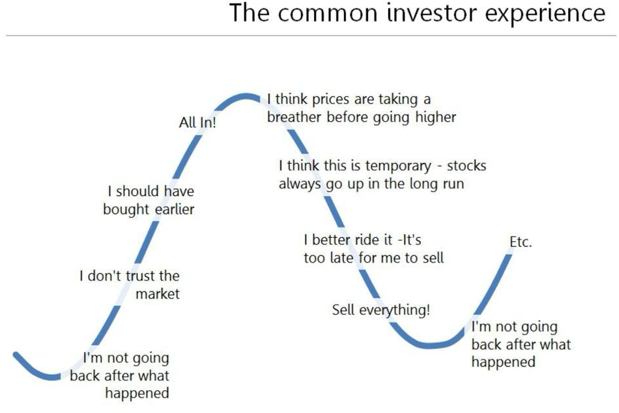
Source: Forbes, 05.05.2022
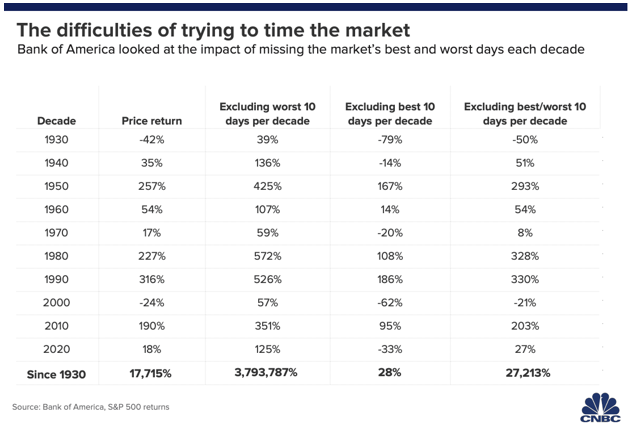
Put another way, sticking with the long-term S&P market from 1930 until 2020 resulted in a gain of 17.715%. In comparison, if you excluded the best 10 days per decade which fearful Alex was doing, the return would have been 28%. In trying to avoid excluding those 10 worst days and shooting for that 3.7 million % return with eliminating the 10 worst days per decade, fearful Alex ended up with 28% over that period.
So, as we move into 2024, let’s remember the back-to-back years of a terrible, very bad market in 2022 which was followed by a fantastic market in 2023 and try to get ourselves off of that emotional roller coaster. Advisors can help you avoid the mistakes of hypothetical fearful Alex which is inside most of us. Talk to an advisor to help you manage your fears and have a happy and healthy 2024!